
Power user
You are here: Power user · Power user
Next: Unstick a loop
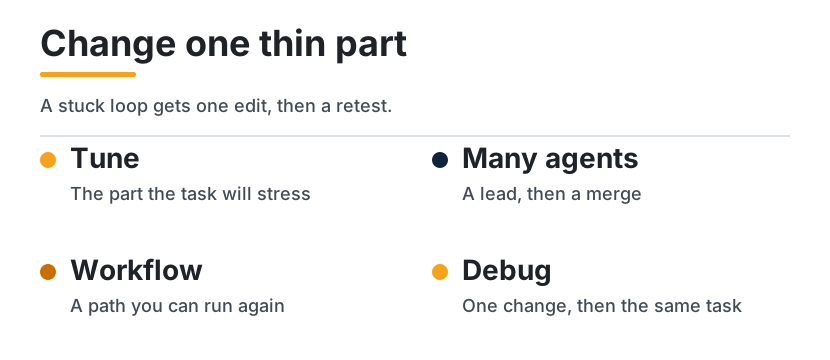
You already run agents. This path is the edit. A thin part is the one piece that is failing: what the agent remembers, the rule that should stop it, or the instructions. Change that piece only. Then run the same task again. You will also design a workflow several agents can repeat.
| Path | Power user |
| Time | Ongoing. One diagnosis is a sitting. A workflow is longer |
| You need | An Operator score sheet, or a real failing trace |
Two changes at once teach you nothing. The trace says which part is thin. You change that part. You run the same task again.
flowchart LR
  T["Tune"] --> M["Many agents"]
  M --> W["Workflow"]
  W --> D["Debug"]
  D --> T
Who this is for
People who are past placement. You have a run, a trace, and a teammate who depends on the result. You want advanced orchestration, a workflow that is yours rather than a product default, and a way to unstick a loop without swapping the model first. If you do not yet have a score or a trace, finish Operator first. The trace is the instrument.
What you will be able to do
- Match a task to the harness part it will stress, and write that match down where the next person will find it.
- Design a lead, phases, and a merge for a job you actually have, and say what the logs must show.
- Turn a repeated multi-step job into a workflow: a skill, a schema, and a gate.
- Take one stuck loop from symptom to a single change, then retest the same task.
- Add to this guide without inventing a number, a price, or a feature.
The route
| Order | Open | You can leave when |
|---|---|---|
| 1 | Unstick a loop | A real failure has one diagnosis and one change |
| 2 | Harness engineering | You can add a note on that page's terms without inventing a benchmark number |
| 3 | Orchestration | A job you have is drawn as a lead, phases, and a merge, with the log lines you require |
| 4 | Write a skill | The workflow's repeated steps live in one file |
| 5 | Research-agent playbook | The workflow's memory has raw, wiki, and schema |
| 6 | Hosted agents | You have run that page's checklist against one product you actually use |
| 7 | Score a run | The same task, after the one change, has a new pass or fail |
| 8 | Case studies | You have opened at least three of the source posts, and kept their claims marked |
| 9 | Style guide and Contributing | A page you would add matches the anatomy, and the source is linked |
Review a gateway belongs in this path when the workflow sends prompts through a proxy. The decision is still use, sandbox only, or do not use.
Tune the harness
Harness engineering treats a weak run as a thin part, not a weak model. Observation, context, control, action, state, verification: write which one the task will stress before you change a prompt. The survey's SWE-bench Verified reading stays on that page, as model–harness pairs, with the survey's caveats. A note you add names the source. It does not introduce a new percentage.
Many agents, one workflow
Orchestration gives you three shapes: a pipeline, a fan-out, and a lead with workers. Worker names on the diagram are illustrative. They are not a product's roster. Pick the shape your job actually has.
A custom workflow, in this guide, is three files a teammate can rerun:
| Piece | Where it lives | Playbook |
|---|---|---|
| The steps that repeat | SKILL.md |
Write a skill |
| What the next run must already know | raw, wiki, schema | Research agent |
| What a person still accepts | the gate on the score sheet | Score a run |
If the job is a hosted product, the workflow includes that product's limits. The checklist on Hosted agents is synthesis from the official pages. Run it against the product you use. On Grok Bot, every bot shares the computer. On a dot, a password change stays with you, and proactive research is read-only.
Quick wins
- Write the symptom in one sentence that names a tool and a count. "It searched twelve times for the same fact" is a symptom. "It felt stuck" is not.
- Circle one row in the unstick table. Close the other rows.
- Before a multi-agent run, list the three log lines you will require: the phase, the worker's artifact, and the merge.
- Open one case-study source post before you repeat a claim from the guide's retelling.
Hands on
1. One stuck loop
Do Unstick a loop on a real failure. Match it to one thin step. Make the smallest edit. Run the same task. Record the new trace next to the old one in Score a run. If you changed two things, you do not yet know which one mattered.
2. A workflow you can hand over
Pick a job that already has more than one step. Draw it with orchestration: lead, phases, merge, or a simpler pipeline if that is the truth. Put the repeated procedure in a skill. Put the durable notes in the wiki layout. Write the stop rule on the same page as the drawing.
3. A page the guide did not have
When the diagnosis is worth keeping, add it where the next person will look. Contributing is the shape. Link the source. Mark a post's claim as per post. Leave a gap where you did not check.
Checklist
- [ ] A real failure is one sentence with a tool and a count.
- [ ] One thin harness part is named, and only that part changed.
- [ ] The same task was run again, and the new trace is stored.
- [ ] A multi-agent job is drawn as pipeline, fan-out, or lead / worker.
- [ ] The drawing says which log lines I require before I trust the merge.
- [ ] The repeated steps are in a skill file.
- [ ] Memory for that workflow is raw, wiki, and schema, or I have written why one of those is empty.
- [ ] A hosted product I use has been through the hosted-page checklist.
- [ ] Any number I repeat is still attached to the page that published it.
Check yourself
- Why does swapping the model come after the thin-step edit?
- What three log lines do you want before you trust a merge?
- Which file will you edit next month when the procedure changes: the prompt, or the skill?
Next level
There is no fifth persona. The next level is the guide itself: a page edit someone else can use. Start at Contributing, match the style guide, and link the source on the day you add the claim. The case studies are the pattern for how a post stays a post.
Sources
This page is a route. The thin-part frame is Guo, Hao, Wang, and colleagues, From Question Answering to Task Completion, on Harness engineering. The order of fixes in a stuck loop is synthesis, as Unstick a loop says. Hosted limits stay on Hosted agents.
Continue
Map | Paths | Glossary | References