

Playbook · Research agent
You are here: Research agent · Power user
Next: How agents remember
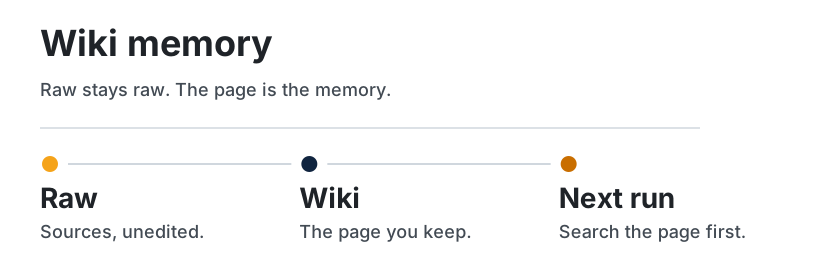
Stand up the smallest version of raw, wiki, and schema. Use it on a question you actually have.
The notes file in the Builder guide is one page and nothing else. Start there if you do not have a folder layout yet. This playbook is that page grown into raw sources, a wiki, and rules.
| Path | Power user |
| Time | About 90 minutes the first time |
| You need | Wiki memory |
| Produces | A folder layout, five rules, and one page written from a real source |
This is synthesis on top of @fleyta88. The post names the three pieces. The files below are a concrete way to keep them. They are not a recovered Karpathy repository.
1. Make the folders
research/
  raw/                 evidence, append-only
    inbox/             posts, pdfs, clips, as they arrived
  wiki/                maintained pages
    index.md
    log.md             one line per run: date, question, pages touched
  SCHEMA.md            the rules below
Keep raw/ boring. A file's name can include the date and the author. Do not summarize inside raw/. The summary is a wiki page.
2. Write the schema on one screen
Put these rules in SCHEMA.md. Edit them when they fail you. Do not keep a second copy in a chat.
- Search
wiki/before openingraw/. - If the wiki answers, say so in
log.mdand stop. - If it does not, read the smallest raw set that could answer, then write or update one page.
- Every non-obvious claim on that page has a source path or URL, and a status: established or per post.
- Gaps are a heading, not an absence. Stale claims get corrected in place, with the new source, and the old source stays linked.
raw/is not rewritten to match the conclusion.- Stop when the page exists and the log line is written. A second pass needs a new question.
3. Give the agent a standing prompt
Short on purpose:
You are maintaining research/wiki using research/SCHEMA.md.
Search the wiki before the raw files.
Write the answer back into a page before you stop.
Mark claims you cannot verify as per post.
Do not invent URLs, numbers, or repository names.
The procedure lives in the schema. The prompt only points at it. That split is prompts and skills.
4. Run one question
Pick a question you cannot answer from memory. A good first question, if you are using this repository as the corpus: "What does the OmniRoute post claim about keys, and what has this guide refused to confirm?"
Watch the trajectory.
| You want to see | You want to stop the run if |
|---|---|
| A wiki search first | It opens raw files before looking |
| One page updated | It answers only in the chat |
| A gap written down | It fills the gap with a plausible URL |
| A log line | It starts a second, unrequested research pass |
5. Ask the same question tomorrow
The second run is the eval. It should search the wiki and get cheaper. If it re-reads everything, the page is in the wrong shape: the answer is buried, or the title would not match a search. Fix the page, not the model. The regression cases live in evals.
6. Cite it the way this guide does
When the source is someone else's post, link the status, mark the claim per post, and add the post to Social references & inspirations if it shaped a page. The rules are in CONTRIBUTING. Your personal wiki can be looser. The moment other people will read it, use the same claim labels.
Check yourself
- Which directory is append-only?
- What does the second run have to do differently from the first?
- Where do the rules live, and where do they not live?
Sources
- @fleyta88 — the three-piece pattern, per post.
- The folder names, the seven rules, and the prompt are synthesis.
Continue
Map | Paths | Glossary | References