
Case study · Local gateway
You are here: Case study · Local gateway · Power user
Next: Motion and web stacks
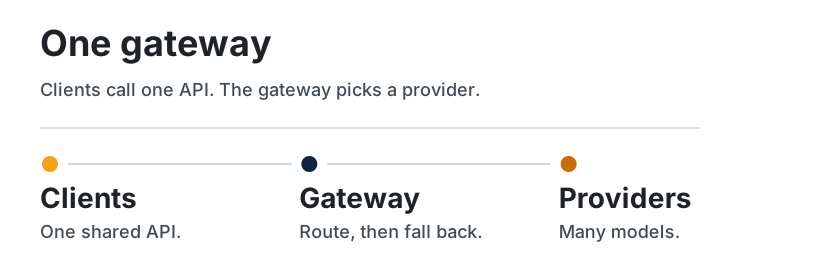
OmniRoute, as one post describes it: a local OpenAI-compatible router in front of a large pool of providers.
| Path | Power user |
| Source | @Bober_smart |
| Posted | 2026-10-08, @Bober_smart |
| Concept | Gateways and routing |
The situation
The post says a local gateway pools free limits from many providers, speaks one API that coding agents already use, falls back when a provider returns 429 or runs out of quota, compresses context, stores keys locally, and speaks MCP plus an agent-to-agent setup. It also leads with a leak and a huge free-token number.
Claims
Every product row is per post. The full table is on the concept page. The claims most often repeated without a source in the room:
| Claim | Keep it tied to |
|---|---|
| 350+ providers, 90+ services, 18 strategies | The post. The strategies are not named |
| 15–95% compression via RTK and Caveman | The post. The engines are not specified here |
| AES-256-GCM and zero telemetry | The post. Not an audit |
| 800 million free tokens, via a leak | The post's hook. Not a capacity plan |
The project link in the post was not resolved. An earlier status by the same author: twitter.com/bober_smart/status/2103462864870686848.
What to steal
The picture: many hosts, one local endpoint, explicit fallback, keys that do not have to sit in a third-party proxy. Then verify it with the review playbook.
What to leave
The leak framing. Any plan to aggregate accounts you do not control. Any percentage you have not measured.
Sources
Continue
- Next study: Motion and web stacks
- Security: Gateways and supply chain
Map | Paths | Glossary | References