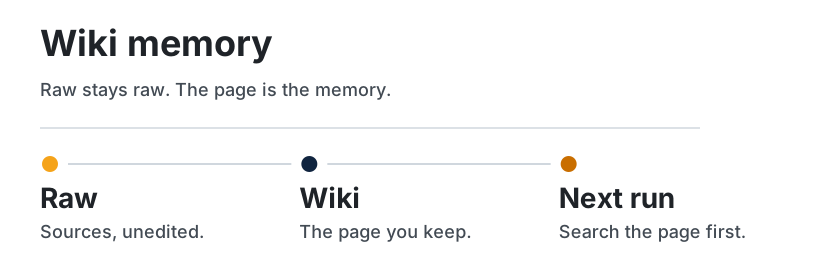

Wiki memory
You are here: Wiki memory · Builder
Next: How agents remember
Make the agent write something worth remembering. The next question searches that writing first.
A single notes file is enough to feel this. The Builder guide stops there on purpose. This page grows that file into raw sources, wiki pages, and rules, so a later run can search what you already decided.
| Path | Builder |
| Time | About 25 minutes |
| You need | ReAct and plan-and-execute |
What you will be able to do
- Explain raw, wiki, and schema.
- Run the compounding loop on a question of your own.
- Say how this differs from fetching passages into a prompt.
The problem, as the post tells it
@fleyta88 describes a workflow the post attributes to Andrej Karpathy (per post). The loop it wants to retire is:
search, then answer, then forget, then search again
In that loop the work product is a chat. A hundred questions leave a hundred transcripts. The alternative in the post:
- Raw sources stay raw.
- The agent reads them and turns the useful parts into linked wiki pages.
- The next question searches the wiki first.
- A gap sends the agent back to the sources.
- The answer is written into the wiki.
- The next run starts ahead of this one.
The post's architecture, in its own words, is three pieces: raw/ as the source of truth, wiki/ as maintained knowledge, and a schema for how updates happen. Search still matters. It stops being the whole product.
Note
Per post. This page teaches the pattern as that post describes it. The post does not include a repository URL, a paper, or a video transcript beyond the status and a related link. This guide does not invent one. The attribution to Karpathy is the post's.
Three pieces
| Piece | Job | Rule |
|---|---|---|
| raw/ | Evidence, kept as it arrived | Append. Do not quietly rewrite. |
| wiki/ | Pages a later run can open, link, and correct | Every non-obvious claim points at a raw source. |
| schema | The rules of the edit | Written down, short enough to follow when you are tired |
A page in the wiki is allowed to hold:
- A claim, with the source.
- Links to neighbor pages.
- An explicit gap ("the post does not name a repo").
- A correction, dated, when a later source disagrees.
The loop
flowchart TD
  Q["Question arrives"] --> S["Search the wiki first"]
  S --> G{"Gap?"}
  G -->|No| A["Answer from the pages"]
  G -->|Yes| R["Read raw sources"]
  R --> W["Write the answer back"]
  W --> K["Link, note gaps, fix stale claims"]
  K --> A
  A --> N["Next run starts smarter"]
The SVG at the top of this page is the same loop, drawn with the two stores on either side.
What this is, next to RAG
RAG (retrieval-augmented generation) fetches passages and places them in the context window for this call. That is a strong way to ground one answer. It does not, by itself, leave a maintained conclusion.
The post argues that the wiki pattern is "bigger than just better RAG" (per post). The established distinction you can use without taking the slogan on faith:
| RAG | Wiki memory | |
|---|---|---|
| Unit | A retrieved passage | A page someone, or something, maintains |
| When it is read | At question time | At question time, first |
| What the run leaves | A transcript, plus whatever the index already held | An updated page |
| Stale facts | Re-fetched if the corpus changed | Corrected in the page, with the new source |
| Search | The product | One tool inside the product |
Use retrieval to find the passage. Use the wiki so you do not have to rediscover the conclusion. The research-agent playbook turns this table into folders and rules.
How agentsphere follows it
| Karpathy-style piece, per the post | This repository |
|---|---|
| raw/ | The original post, linked from the page and listed in references |
| wiki/ | docs/ |
| schema | CONTRIBUTING |
The picture of that flow is knowledge-flow-light.svg, with a dark twin beside it. The four kinds of memory, retrieval, reflection, and compaction are how agents remember. In the harness frame, this wiki is the state and artifact store, and the decision of what to load is the context manager: harness engineering. Saving a source without updating a page is the forgetful loop, wearing a git commit.
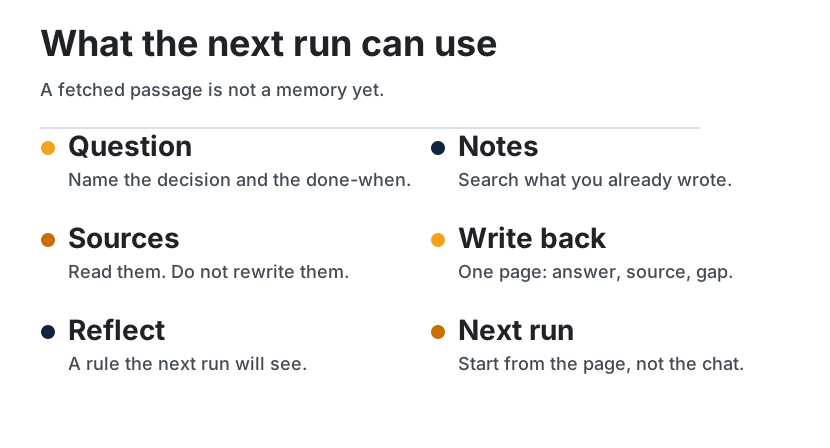
A page worth writing
After a run, the wiki page should let a stranger answer the same question without the transcript. A reliable shape:
- The question, in one sentence.
- The answer, in a few sentences.
- A claim table: claim, status, source URL.
- Open gaps.
- Links to the pages next door.
If you cannot fill the claim table, you are still in the chat.
A page that passes
This is the shape, filled for a question the guide already answers. Copy the headings, not the conclusion, when the question is yours.
# Does the OmniRoute post name a repository?

## Answer
Not on this page. The post's project link is shortened. This page does not guess the destination.

## Claims
| Claim | Status | Source |
| --- | --- | --- |
| OmniRoute is described as a local gateway that pools provider limits | per post | https://x.com/Bober_smart/status/2108293657552117850 |
| A confirmed git URL was in the post | gap | the same post; the project link is shortened |

## Gaps
The repository URL. Do not replace this heading with a search result that merely shares the name.

## See also
Gateways and routing.
A stranger can answer the question from the page. The next run should search this page and stop. That is the whole pattern.
Check yourself
- What are the three pieces, and which one is append-only?
- A later post contradicts a wiki page. What do you change, and what do you leave?
- Why can a perfect retrieval index still leave you with a hundred dead chats?
Sources
- @fleyta88 — 2026-10-09. The full pattern above, per post. Related post: a status by @gippp69.
- Established distinction between retrieving passages and maintaining a conclusion. The "bigger than better RAG" phrasing is the post's.
Continue
- Next: How agents remember
- Then: Tools and MCP
- Practice: Research-agent playbook
- Case study: Compounding wiki
Map | Paths | Glossary | References