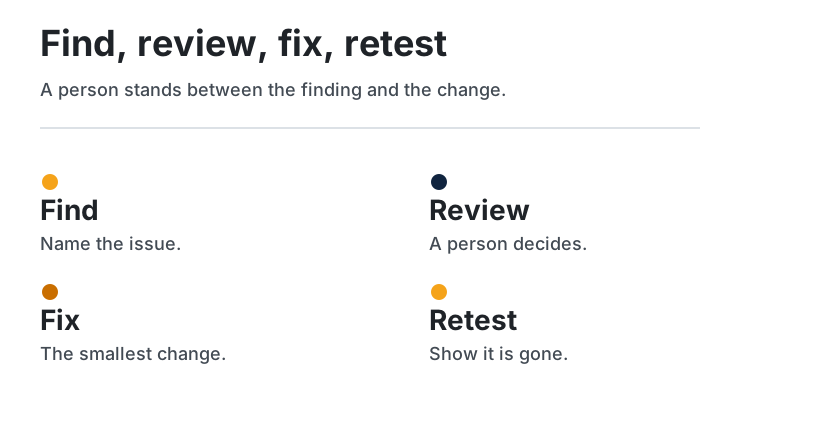

Find, review, fix, retest
You are here: Find, review, fix, retest · Operator
Next: Gateways and supply chain
A security agent is still the agent loop, pointed at risk, with a person standing on the step that changes the system.
| Path | Operator |
| Time | About 12 minutes |
| You need | Threat model |
What you will be able to do
- Restate the Antigen post as a six-step review loop.
- Point at the step a person owns.
- Say what this page will not teach.
What the post says
@antigenco introduced Antigen as an offensive security agent that maps, exploits, and secures an attack surface (per post). The mechanism in the post is: it probes the system the way a hostile tester would, ships fixes for the team's review, and tests again to check that the issues were patched. The post contains the status and a video URL. It does not contain a resolved product or documentation link. This guide does not invent one.
| The post's verb | How this guide draws it |
|---|---|
| Maps | 1. Map the surface you are allowed to look at |
| Probes / exploits | 2. Probe, inside an authorization you already have |
| (implied) | 3. Record findings as evidence |
| Ships fixes for review | 4. A person accepts the fix. 5. Then it can land |
| Tests again | 6. Retest. A miss returns to probe |
flowchart LR
  Map["1 Map"] --> Probe["2 Probe"]
  Probe --> Findings["3 Findings"]
  Findings --> Review["4 Human review"]
  Review --> Fix["5 Ship the fix"]
  Fix --> Retest["6 Retest"]
  Retest --> Probe
The SVG makes step 4 larger on purpose. An agent that "secures" a system by patching it unseen has skipped the only step that makes the rest safe to automate.
Warning
Authorization and altitude. Run this kind of agent only against systems you are explicitly allowed to test. This page does not explain how to probe, how to exploit, or how to confirm a vulnerability. Those procedures stay out of the guide. The lesson that belongs in a field guide is the gate and the retest.
What "done" means
A finding is done when:
- The evidence is written down for a reviewer.
- A person has accepted the change.
- A retest, by the agent or by the reviewer, agrees the finding is gone.
- The wiki or the ticket records what changed, so the next run does not rediscover a ghost.
That last bullet is wiki memory applied to security work. A hundred scan transcripts are the forgetful loop. A page per finding, with status, is the compounding one.
What to demand if you buy this
Synthesis, a buying list, not a feature list from the post:
| You can see | You cannot see |
|---|---|
| The authorization the run was given | A promise that "offensive" implies permission |
| Findings as evidence, not only a score | A silent patch to the default branch |
| The diff before it merges | A retest that only re-reads the agent's own summary |
| A person on the merge |
Check yourself
- Which step is the human's, in the diagram?
- What did the post claim that this page refuses to expand?
- How does a finding page keep the next run from starting at zero?
Sources
- @antigenco — 2026-10-08. Map, probe, fix for review, retest. Per post.
- Synthesis: the six-step drawing and the buying list. The exploit itself is intentionally absent.
Continue
- Next: Gateways and supply chain
- Case study: Offensive security agent
- Previous: Threat model
Map | Paths | Glossary | References