
Playbook · Your first agent
You are here: Your first agent · Explorer
Next: Harness engineering
Sketch one agent on a single page, then walk one task through the loop. You do not need a model, an API key, or a repository.
| Path | Explorer |
| Time | About 40 minutes |
| You need | What is an agent and the loop |
| Produces | agent-card.md: six parts, a stop rule, and one trace |
This is synthesis. The card is a way to see an agent before you buy one.
1. Pick a task you already do
One sitting, one outcome. Good first tasks are small and checkable:
- Turn three links into a page a teammate can trust.
- File the bugs in a changelog as tickets.
- Summarize a meeting into decisions and open questions.
Write the task as a sentence with a done-when. "Look into our agents" is not a task. "A page that lists the six parts of the bot we already run, with a gap where you are unsure" is a task.
2. Fill the card
Copy this into agent-card.md and replace the brackets.
# Agent card

Task:
Done when:

| Part | This agent |
| --- | --- |
| Model | [who chooses the next step] |
| Instructions | [the rules that do not change mid-run] |
| Tools | [named actions: read, search, write, and what each may touch] |
| Memory | [what must still exist tomorrow] |
| Environment | [laptop, remote runner, or CI, and who can see the files] |
| Stop | [the condition, plus a budget] |
If a row is "the chat window," say so. An empty memory row is a finding, not a failure of the exercise.
3. Trace one pass
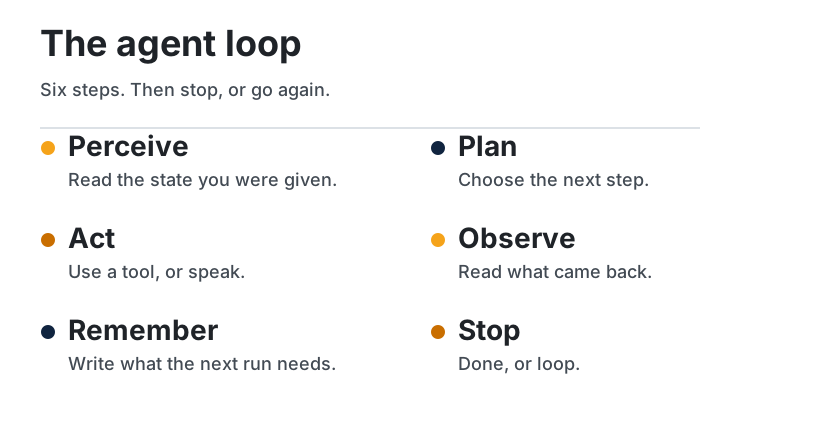
Under the card, add six lines for a single pass. Use a real input. Here is a filled trace for the task "say whether a post names a repository":
| Step | What happened |
|---|---|
| Perceive | The goal is one page. The input is the post URL. |
| Plan | Open the post before writing any sentence about a repo. |
| Act | Open the post. |
| Observe | The post names a product. The project link is shortened. |
| Remember | Write: "no confirmed repository URL," and link the post. |
| Stop | The page has the link, the gap, and no guessed URL. |
Your trace should be this specific. "The agent does research" is the step you still owe.
4. Mark the thin step
Circle the step that would fail first if you ran this tomorrow with a model in the loop. The usual ones:
| If you notice | The thin step | The smallest fix |
|---|---|---|
| It would search again next week | Remember | Name the file that must exist |
| It would keep going after the page exists | Stop | Write done-when, and a maximum number of steps |
| It would claim the file was written | Observe | Require a read of the file after the write |
| It would plan and never open the post | Act | The next step after a plan is a tool call |
5. Check the card
- [ ] The task names an artifact, not a mood.
- [ ] Done-when is something a second person could grade.
- [ ] Every tool has a name and a thing it is allowed to touch.
- [ ] Memory is a file or a record, not "it will remember."
- [ ] The environment says where the files live.
- [ ] Stop includes both the goal and a budget.
- [ ] The trace has six rows, and one of them is an observation of a real result.
- [ ] No row invents a URL, a benchmark, or a product feature.
Check yourself
- Which row of the card is not a tool, even though people often stuff it into the prompt?
- What makes a trace different from the final page?
- What will you add to the card before you let a model call a write tool?
Sources
The six parts and the six steps are the guide's established frame. The card and the checklist are synthesis.
Continue
- Harness engineering, to name the runtime around the card
- Research agent, when you want the card to become folders
- Unstick a loop, when a run misbehaves
- What is an agent
Map | Paths | Glossary | References